Slate
SCOTTISH ROMANCE: My Sinful Surrender to a Highlander Werewolf (Scottish Werewolf Pregnancy Romance) (Historical Medieval Shape Shifter Paranormal Science Fiction Short Stories)Slate, whose birth name is Howard, is introduced as an imposing man whose violence is directed against an abusive husband rather than an innocent victim. His decisive significance lies in the way he becomes both agent of immediate protection and the emotional bridge between Marie’s damaged domestic life and a future she can actively rebuild. The narrative presents him through surfaces—leather, muscle, a shaved scalp, and tattoos—then complicates those surfaces by revealing the gentle person Marie remembers beneath them.
Identity and Introduction
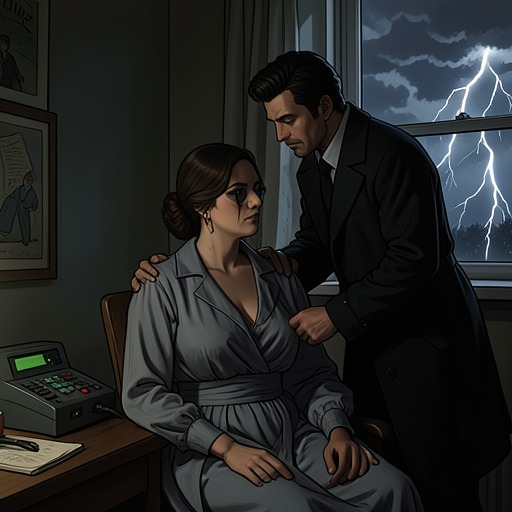
Slate first appears when Marie returns home early and finds an enormous man looming over Chris in an easy chair. The man is demanding payment for a debt, and his leather-clad arm has just struck Chris across the jaw, leaving him swollen, slumped, and moaning. Marie is frightened by the intruder’s size and anger, but the scene also exposes the power reversal at the center of her marriage: Chris, who habitually mistreats Marie, is suddenly helpless before someone stronger than himself. When the stranger asks who she is, Marie identifies herself as Chris’s wife, and he answers that he is the bill collector.
The encounter carries a further element of recognition. Marie finds the man vaguely familiar, and he identifies himself as Slate. When she connects that nickname with Howard, he firmly asks her not to use the old name, explaining that nobody around him has called him that for years. The refusal is more than casual preference: it marks a boundary between the boy Marie once knew and the adult persona he has constructed. Slate is therefore both familiar and transformed, a figure whose identity must be approached through memory without reducing him to his past.
Protection and the Rescue of Marie
Slate’s physical presence initially seems threatening, yet his role quickly separates him from Chris. Chris addresses Marie with contempt, calling her lazy and accusing her of avoiding work, while Slate’s deeper voice carries less venom than Chris’s. The contrast makes clear that size and aggression do not determine moral character in the same way. Slate’s violence is frightening, but it is directed toward a man whose own conduct has made the household a dark and dangerous place.
After Marie witnesses Chris being beaten, she fears that Chris will punish her simply for having seen his humiliation. Slate becomes aware that the danger does not end with the bill collector’s visit. His presence gives Marie a temporary shield from the consequences she expects at home, and the later account states that Slate’s associates ensured Chris understood that the marriage was over. Chris’s hospital stay is described as long enough for him to grasp that Marie had left his control, making Slate’s intervention consequential beyond the immediate beating.
Slate also provides Marie a place of safety. He leads her into an apartment, unlocks the door, turns on the light, and closes the door behind her. The setting is not presented as luxurious—the wood is cracked—but it functions as a threshold away from the house where she has lived under fear. His leather-and-Ivory scent, which Marie finds intoxicating, fuses the concrete details of his appearance with the bodily immediacy of her renewed attraction. Protection in Slate’s arc is therefore practical and sensory: he removes her from immediate danger while making another kind of life imaginable.
Emotional Recognition and Relationship with Marie
Marie’s relationship with Slate is shaped by a startling comparison. She realizes that, in roughly an hour with him, she feels more connected than she has with Chris in ten years. The statement measures the depth of her marital deprivation as much as the intensity of her new attraction. Her desire has been dormant for years, but Slate’s presence awakens a long-forgotten interest in intimacy, and she finds herself touching him despite the emotional injuries she has carried.
Slate does not treat Marie’s situation as a simple romantic opportunity. While holding her hands against his chest, he tells her that he never would have imagined finding her in that house with Chris and asks whether she remembers that she deserves better and can do more. His appeal is centered on her worth and capacity, not merely on his own ability to possess or rescue her. The phrasing also reveals that he sees the house as a dark hole, an environment that has obscured the person Marie might have become.
Marie explains that she had been dating Chris while completing paralegal school, became pregnant, and lost the baby after they married. She cannot determine whether Chris never forgave her or whether she has been punishing herself. Her account is explicitly complicated rather than neatly resolved. Slate responds by squeezing her hands and drawing her closer, creating a moment in which bodily tenderness accompanies, rather than erases, her admission of grief and guilt. The relationship thus begins amid overlapping trauma, desire, and the possibility that recognition by another person can interrupt self-punishment.
Change, Domestic Independence, and Ending
Several months later, Marie wakes beside Slate and smiles at his sleeping face. Chris has become a distant nightmare, and the consequences of Slate’s intervention have allowed her to treat the former marriage as finished rather than ongoing. She is no longer merely sheltered from Chris; she is preparing a new home, meeting a moving van at a storage unit, and making an apartment ready for living. The practical work of relocation gives material form to her emotional escape.
Marie’s changed body also records the new relationship. In the shower, she notices dark pink marks left on her skin during the previous night and associates them with the intense sexual pleasure Slate gave her. The narrative makes sexuality part of her recovery, though it also shows how quickly physical desire is woven into the larger language of rescue. Her body is no longer presented only as a site of bruises, cuts, and fear; it has become a source of sensation she can recognize as her own.
The final recognition is that Howard has not disappeared beneath Slate’s appearance. Marie is amazed that her old feelings for Howard blend effortlessly into the relationship she develops with Slate. Despite the shaved scalp, leather clothing, and multiple tattoos, he remains the same sweet soul she once knew. This continuity complicates the apparent metamorphosis: the nickname and style signify chosen adulthood, while the tenderness Marie remembers survives underneath. Slate’s ending is consequently not a revelation that one identity was false, but an acceptance that the intimidating exterior and the gentle interior belong to the same person.
Narrative Function and Thematic Significance
Slate occupies the protective-love role in a romance built around escape from domestic abuse. The story’s justice is partly institutional, since Chris is hospitalized, but it is more decisively enforced through private masculine power: Slate and his associates make Chris understand that his claim over Marie is finished. The pattern resembles vigilante or underworld justice, yet the narrative distinguishes Slate from Chris by linking force to protection, boundaries, and Marie’s freedom rather than to humiliation within an intimate relationship.
His character also carries the book’s strongest appearance-versus-reality contrast. Chris’s ordinary domestic position conceals cruelty, whereas Slate’s leather and tattoos make him appear dangerous even as he proves emotionally attentive. Marie’s judgment of him changes not because his appearance becomes more conventional, but because experience teaches her to read conduct rather than surface. The lesson is condensed in her realization that people should not be judged by their covers, but Slate’s arc gives that lesson a concrete emotional history: Howard’s remembered sweetness persists through the persona of Slate, and Marie’s own life begins again when she learns to recognize both.
Slate’s function is therefore larger than that of a rescuer who defeats an antagonist. He is the figure through whom the narrative converts a household organized by debt, fear, and self-blame into one organized by choice, movement, and renewed intimacy. His intervention ends Chris’s immediate authority, his apartment supplies a temporary refuge, his language restores Marie’s sense of deserving better, and his later relationship accompanies her move into an independent home. The protection matters because it leads beyond protection: it opens the possibility that Marie can recover not only safety, but a self no longer defined by what happened in the marriage.